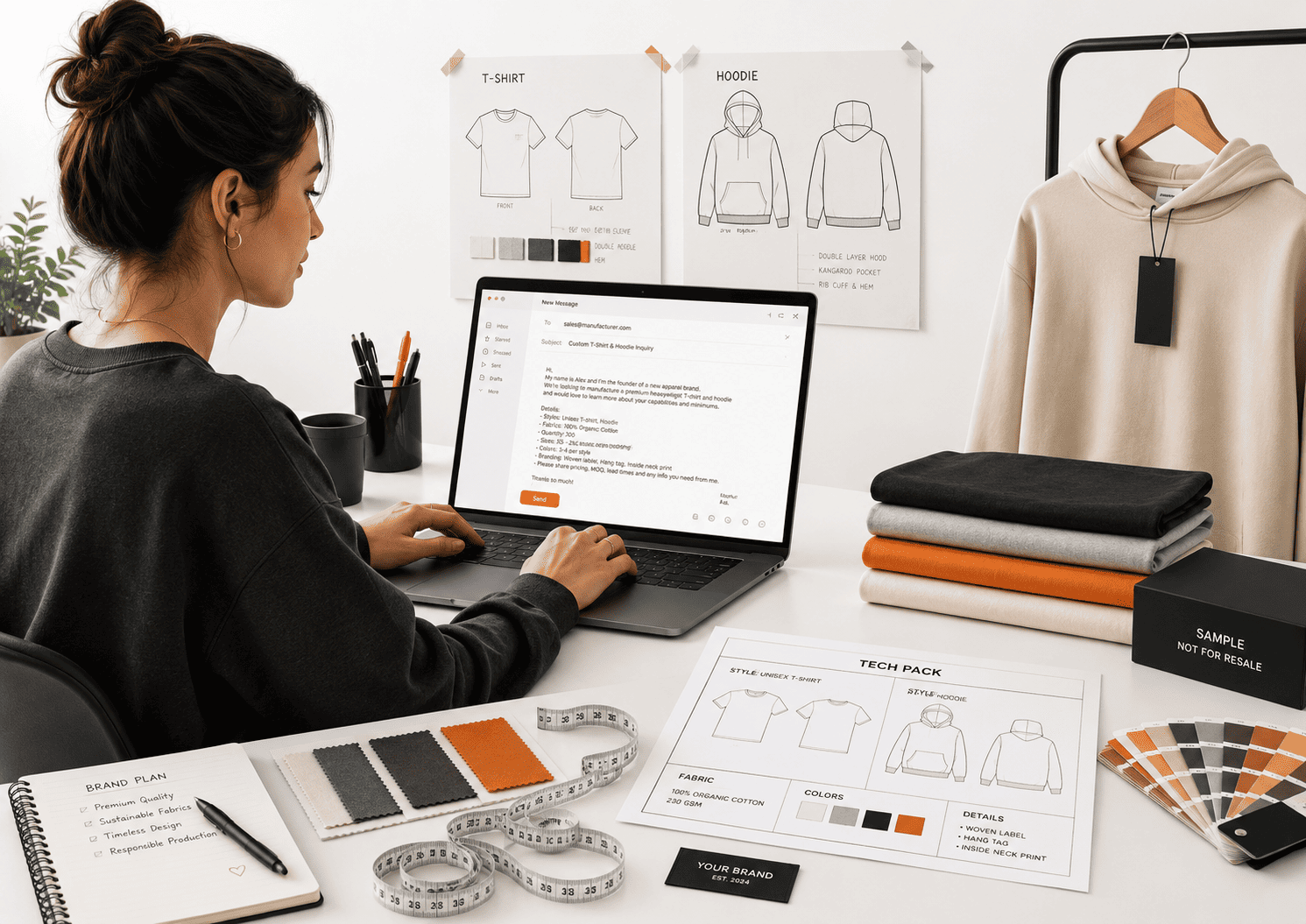
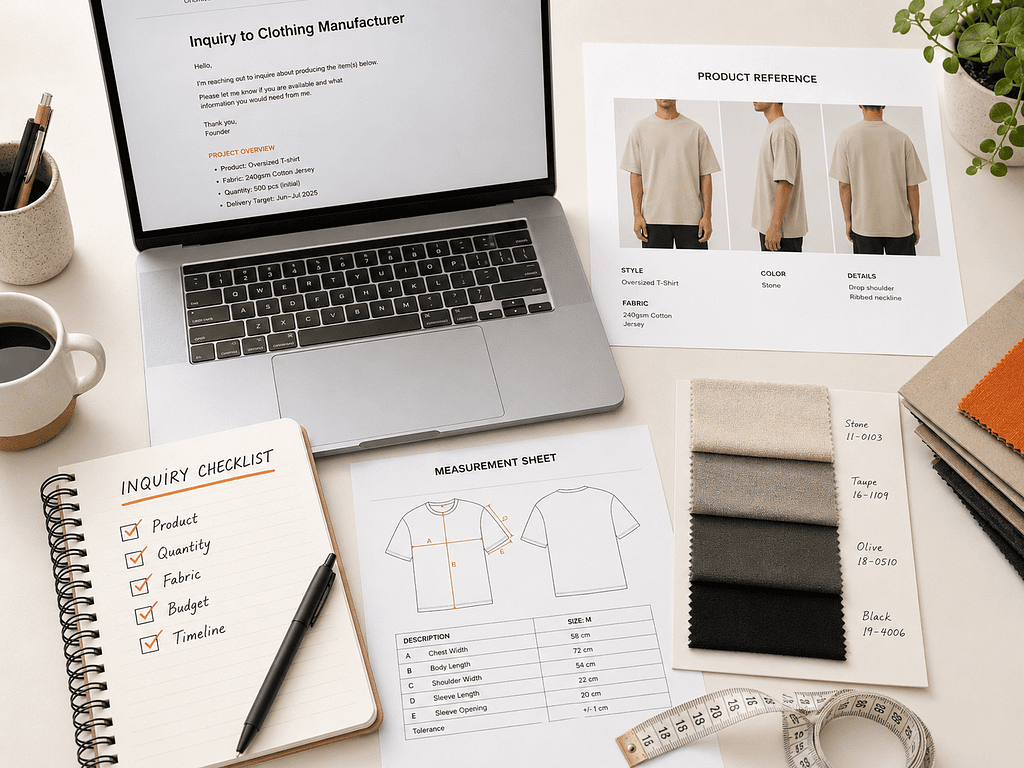
Finding a clothing manufacturer can feel surprisingly frustrating, especially when you are just starting your brand.
You may spend hours searching online, build a list of factories, send out 10 or 20 emails, and then wait.
A few days pass.
No reply.
Or maybe one factory replies briefly, asks for more details, and then the conversation goes nowhere.
At that point, many new brand owners start wondering:
“Are overseas clothing manufacturers just hard to communicate with?”
“Am I too small for them?”
“Do I need a full tech pack before anyone takes me seriously?”
“Why is nobody willing to give me a price?”
The truth is, many manufacturers are not ignoring you because they are rude. In many cases, they simply cannot tell from your first message whether your project is clear, serious, and workable.
A clothing manufacturer inquiry is not just a message.
It is a signal.
From your first email, a factory is already trying to understand whether you know what product you want to make, whether your quantity is suitable for production, whether you have enough information for an estimated quote, whether your budget is realistic, and whether you are looking for custom manufacturing or ready-made clothing from a catalog.
You do not need to have everything perfect before contacting a manufacturer. You may not have a complete tech pack yet. You may not know every fabric name or production process.
But you do need to give the manufacturer enough useful information to understand your project and decide whether they can help.
This guide explains how to write a clothing manufacturer inquiry that actually gets a reply — from the factory’s point of view.
Quick Answer: What Should a Clothing Manufacturer Inquiry Include?
A good clothing manufacturer inquiry should clearly explain what you want to make, how many pieces you plan to order, what quality level you expect, and what information you already have.
| Information to Include | Why It Matters | Example |
|---|---|---|
| Product type | Helps the factory understand the category | Oversized T-shirt, hoodie, activewear set, pajama set |
| Tech pack or reference images | Helps the factory understand the design | Tech pack, front/back photos, fit references |
| Quantity by style and color | Determines MOQ, cost, and production feasibility | 150 pcs in one color across 5 sizes |
| Fabric direction | Affects sourcing, price, hand feel, and lead time | 260gsm cotton jersey, 380gsm fleece, nylon spandex |
| Decoration details | Printing, embroidery, labels, and washes affect cost | Screen print, chest embroidery, woven label |
| Target price or budget | Helps the factory recommend realistic options | USD 18–22 per piece depending on workmanship |
| Timeline | Helps check whether sampling and bulk production are possible | Sample in 3–4 weeks, launch in September |
| Shipping country | Helps estimate delivery options and export requirements | USA, UK, Germany, Australia |
The more clearly you provide this information, the easier it is for a factory to reply with useful feedback.
First, Understand What Type of Manufacturer You Are Contacting
One of the most common messages new buyers send is:
“Can you send me your catalog?”
This question sounds normal from the buyer’s side. If you are new to sourcing, it makes sense to assume a clothing factory has a catalog of styles ready for you to choose from.
Some suppliers do work this way. Blank apparel suppliers, wholesalers, or stock clothing vendors may have ready-made T-shirts, hoodies, leggings, jackets, or other items available. You choose a style, add your logo, and place an order.
But many custom clothing manufacturers do not mainly operate like that.
A custom apparel factory is usually not a fashion store or a ready-stock warehouse. Most of the time, it produces based on the customer’s own design, reference images, tech pack, fabric direction, measurements, colors, trims, labels, and order quantity.
The factory may have previous production photos, fabric options, workmanship examples, or category experience, but it may not have a catalog full of finished styles for sale.
Before you write your first inquiry, ask yourself:
Am I looking for ready-made clothing, or custom clothing production?
| Supplier Type | Best For | What to Ask For |
| Blank apparel supplier | Ready-made T-shirts, hoodies, caps, basics | Catalog, stock colors, logo printing options |
| Wholesaler | Fast purchase of existing styles | Product list, available inventory, wholesale price |
| Print-on-demand supplier | Very small quantity or testing designs | Print options, fulfillment service, no MOQ |
| Custom clothing manufacturer | Your own fit, fabric, labels, trims, and design | Sampling, MOQ, fabric sourcing, production quotation |
If you only need existing blank products with your logo, you may be better suited to a blank apparel supplier or wholesaler.
If you want your own fit, fabric, color, label, print, embroidery, wash, or construction details, then you are looking for a custom clothing manufacturer.
And for custom manufacturing, your inquiry needs to include more than:
“Send catalog.”
Or:
“How much?”
A better opening would be:
“We are developing a custom oversized T-shirt for our brand and would like to know if you can help with sampling and production.”
Or:
“We are looking for a manufacturer for custom women’s activewear. We have reference images and are planning an initial order of around 150 pieces per color.”
This immediately gives the factory context. It tells them what you want to make, what type of production you need, and whether the project may be suitable.
Why “Can You Make This?” Is Not Enough
Another common inquiry is:
“Hi, can you make this?”
Then the buyer attaches one product photo.
From the buyer’s point of view, this feels clear. They want to know whether the factory can make something similar.
But from the manufacturer’s side, one photo is usually not enough to give a serious answer.
A photo can show the general style, but it does not show the full production requirements.
For example, if you send a hoodie photo, the factory still needs to know the fabric, fabric weight, fit, quantity, colors, sizes, decoration, labels, trims, target price, sample timeline, and bulk production schedule.
Without these details, the factory may be able to say, “Yes, we can make hoodies,” but they still cannot give you a useful price, lead time, or production suggestion.
Vague Inquiry vs. Useful Inquiry
| Weak Inquiry | Why It Is Hard to Reply | Better Inquiry |
| “Can you make this?” | No fabric, quantity, size, or price direction | “Can you make a custom oversized hoodie similar to this reference, around 380gsm fleece, 150 pcs in one color?” |
| “How much for a T-shirt?” | A T-shirt can vary greatly in fabric, fit, print, and MOQ | “Could you estimate the price range for a 220–260gsm oversized cotton T-shirt with front screen print?” |
| “Send catalog.” | Custom factories may not sell ready-made styles | “Do you have previous production examples for custom streetwear hoodies?” |
| “Do you make activewear?” | Too broad to evaluate | “Can you make women’s leggings and sports bras in nylon spandex fabric with custom labels?” |
| “Best price?” | Price depends on confirmed design and quantity | “Our target is USD 18–22 per piece. Is this realistic for this design and quantity?” |
The problem is not that these questions are wrong. The problem is that they are too broad.
A “T-shirt” can be a basic 180gsm cotton tee, a 260gsm oversized streetwear tee, a garment-dyed vintage washed tee, or a technical performance tee with bonded seams and reflective print.
They are all T-shirts, but the cost and production process are very different.
So instead of asking:
“How much is a hoodie?”
A better question would be:
“We are developing an oversized hoodie in around 380gsm cotton fleece, with chest embroidery and a custom woven label. Our first order plan is around 150 pieces in one color across 5 sizes. Could you let us know your sample cost, MOQ, estimated bulk price range, and production lead time?”
This does not need to be perfect. But it gives the manufacturer something to work with.
The Information a Clothing Manufacturer Actually Needs
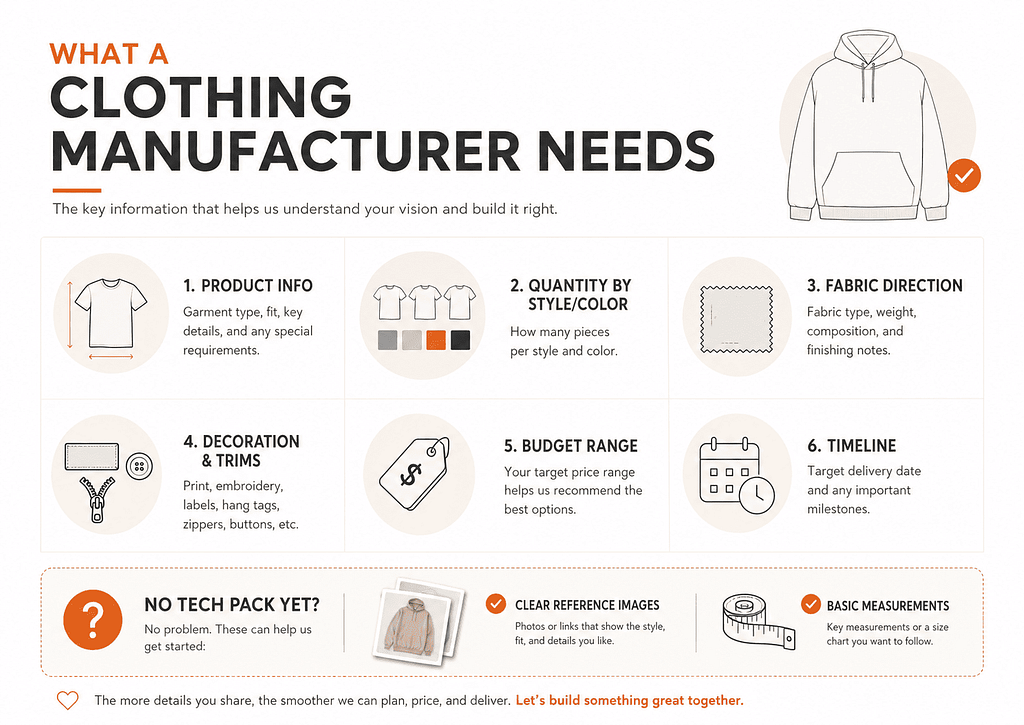
A good manufacturer inquiry does not need to be long or overly formal.
It just needs to include the right information.
You are not trying to impress the factory with perfect industry language. You are trying to help them quickly understand your project and decide whether they can support it.
Manufacturer Inquiry Checklist
| Information | What to Provide | Why It Matters |
| Product category | T-shirt, hoodie, jacket, leggings, dress, pajama set | Helps the factory judge whether it fits their production capability |
| Design details | Tech pack, reference images, sketches, measurements | Helps estimate pattern, sampling, and production complexity |
| Quantity | Pieces per style, per color, and size range | Determines MOQ, cutting efficiency, and unit cost |
| Fabric | Fabric type, GSM, hand feel, stretch, texture | Affects sourcing, price, quality, and lead time |
| Decoration | Print, embroidery, wash, labels, trims, packaging | Affects workmanship, cost, and sampling requirements |
| Budget | Target price or price range | Helps match suitable fabric and process |
| Timeline | Sample deadline, launch date, bulk delivery target | Helps check whether the schedule is realistic |
| Shipping destination | Country or region | Helps estimate logistics and export documents |
1. Product Information
Start by telling the manufacturer what you want to make.
For example:
“We are developing oversized cotton T-shirts.”
“We are looking for a manufacturer for women’s activewear sets.”
“We want to produce custom heavyweight hoodies for our streetwear brand.”
“We are working on a men’s pajama collection.”
“We are developing a custom denim jacket.”
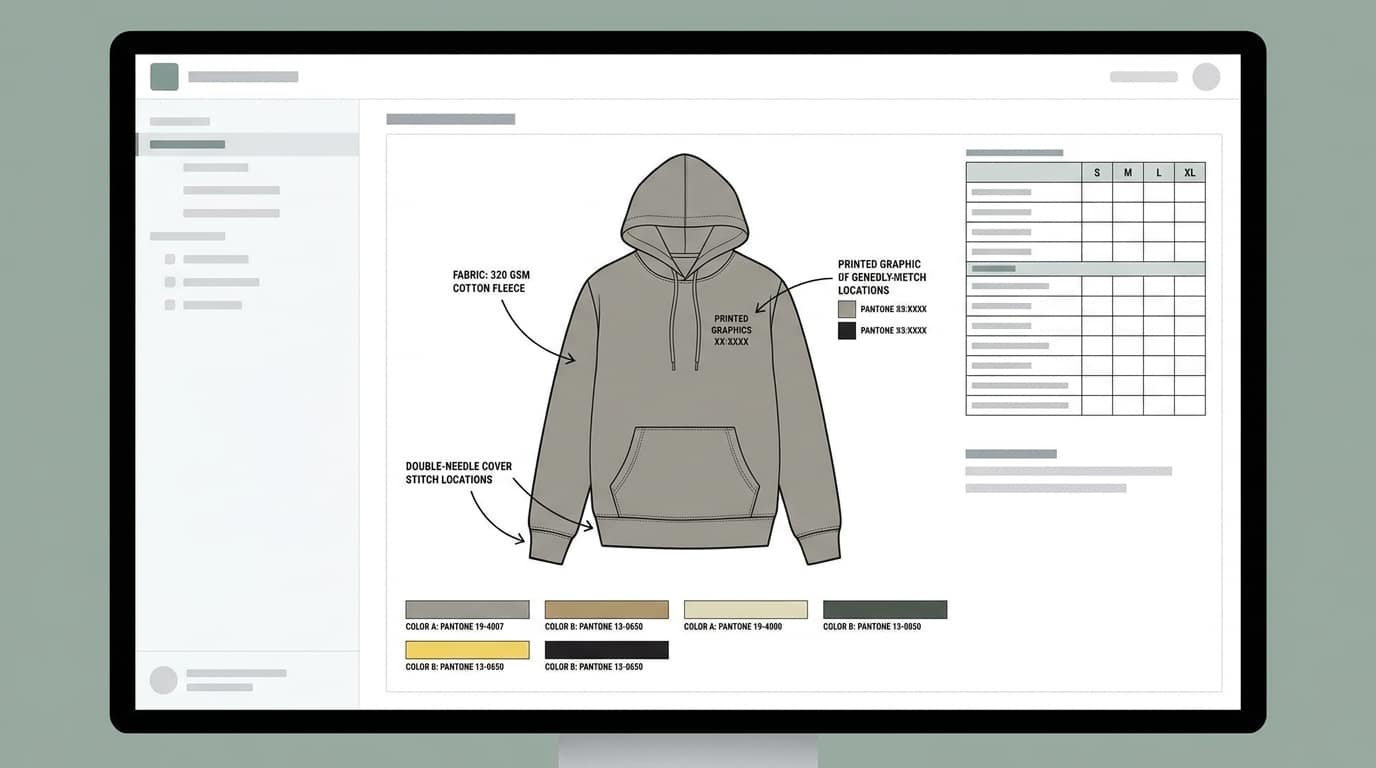
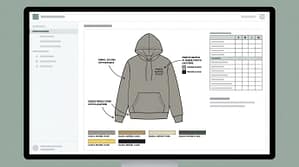
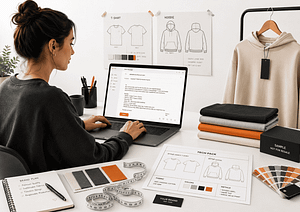
If you have a tech pack, attach it. A tech pack helps the manufacturer understand your design, measurements, fabric requirements, trims, labels, artwork, and construction details.
If you do not have a tech pack yet, clear reference images can also help.
Try to provide multiple angles if possible: front view, back view, side view, fit references, fabric texture, print or embroidery placement, and any special details.
One image is better than nothing, but several clear references are much more useful.
2. Quantity Per Style and Per Color
Quantity is one of the most important details in any clothing manufacturing inquiry.
Many new buyers say:
“We want to order 100 pieces.”
But for a factory, this is still not clear enough.
Do you mean 100 pieces of one style in one color?
Or 100 pieces total across 3 styles?
Or 100 pieces split into 4 colors and 6 sizes?
These are completely different situations.
For custom clothing production, quantity affects fabric sourcing, dyeing, cutting efficiency, size grading, production planning, and final cost.
| Quantity Situation | Factory View | Possible Result |
| 150 pcs, one style, one color, 5 sizes | Clear and easier to plan | More likely to be workable |
| 300 pcs, two colors, 150 pcs per color | Clear color split | Easier to quote and produce |
| 100 pcs total, 4 colors, 6 sizes | Too fragmented | Difficult for custom production |
| 30–50 pcs per style | Very small for factory production | May need POD, blanks, or local studio |
| No quantity provided | Impossible to judge MOQ or cost | Factory may ask for more details or not reply |
Instead of writing:
“We want 100 pieces.”
Write:
“We are planning 150 pieces for one hoodie style, in one color, across 5 sizes.”
Or:
“We have 2 styles, each with 2 colors. We are planning around 150 pieces per color.”
If your quantity is still uncertain, you can say:
“Our first order target is around 100–150 pieces per style, depending on MOQ and price.”
That is still much better than giving no quantity at all.
3. Fabric Direction
You do not need to know every technical fabric term before contacting a manufacturer, but you should give some direction.
For example, you can mention:
- cotton jersey
- French terry
- fleece
- nylon spandex
- polyester spandex
- modal
- bamboo
- denim
- linen
- rib fabric
- performance fabric
If you know the fabric weight, include it:
“220gsm cotton jersey”
“380gsm cotton fleece”
“280gsm nylon spandex”
“14oz denim”
If you do not know the exact fabric, describe the hand feel or use.
| What You Know | How to Describe It |
| You know the fabric name | “We want 260gsm cotton jersey.” |
| You know the product use | “We need breathable, stretchy fabric for activewear.” |
| You know the hand feel | “We want a smooth, soft fabric suitable for pajamas.” |
| You know the structure | “We want a heavyweight hoodie fabric with a structured feel.” |
| You have a reference garment | “We can send a reference sample or photos of the fabric texture.” |
A good manufacturer can usually recommend fabric options, but they need a starting direction.
4. Decoration and Special Processes
If your garment includes any decoration or special process, mention it in your first inquiry.
This may include:
- screen printing
- DTG printing
- DTF printing
- embroidery
- 3D embroidery
- appliqué
- heat transfer
- woven label
- silicone label
- garment dye
- acid wash
- enzyme wash
- distressing
- custom zipper
- custom buttons
- custom packaging
These details can significantly affect price and lead time.
A plain hoodie and a hoodie with large embroidery, garment wash, custom labels, and special packaging are not the same project from a production point of view.
| Process | Why It Affects the Quote |
| Large embroidery | More stitch count, more machine time, higher cost |
| Screen printing | Depends on color count, size, placement, and artwork |
| Garment wash | Adds washing process, shrinkage control, and color risk |
| Custom labels | Requires label development, MOQ, and approval |
| Custom zippers/buttons | May require sourcing, mold cost, or higher MOQ |
| Special packaging | Adds material cost and packing labor |
If you already have artwork files, mention whether you can provide AI, PDF, PSD, or high-resolution files.
If the artwork is not final yet, say that clearly too.
5. Target Price or Budget Range
Many buyers hesitate to share their target price because they worry the factory will simply quote higher.
In reality, for a serious custom manufacturer, a budget range can make the conversation much more efficient.
A factory is not only trying to guess the highest price. A good factory is trying to understand what level of product is realistic for your market.
If your budget is strong, say it. This helps the manufacturer recommend better fabrics, better finishing, and a solution that matches your quality expectations.
If your budget is limited, say that too. The factory may suggest a simpler construction, a more cost-effective fabric, or a different decoration method.
And if your target price is not workable, you can find out early instead of spending weeks discussing a project that cannot be produced within your budget.
| Buyer Message | Factory Can Do |
| “Our target is USD 18–22 per piece.” | Check whether the design, fabric, and quantity can match this range |
| “We want a premium product and are flexible on price.” | Recommend better fabric, finishing, and workmanship |
| “We need the lowest possible price.” | Suggest simpler construction or more basic materials |
| “We do not have a target price.” | Only give a rough range, or ask for more information |
You can write:
“Our target price is around USD 18–22 per piece, depending on fabric and workmanship.”
Or:
“We are aiming for a premium product and are flexible on price if the quality is right.”
Or:
“We are still comparing options, but we would like to understand what is realistic for this design at our quantity.”
You do not need to reveal your entire business strategy. But a realistic price range helps both sides avoid wasting time.
6. Timeline
Finally, include your timing.
Do you need a sample in 2 weeks, 4 weeks, or 2 months?
Do you have a launch date?
Do you need production completed before a photoshoot, event, or seasonal release?
For custom apparel, sampling, fabric sourcing, printing, embroidery, revisions, bulk production, quality control, and shipping all take time.
A simple sentence is enough:
“We hope to receive the first sample within 3–4 weeks if possible.”
Or:
“We are planning to launch in September and would like to understand your sampling and bulk production timeline.”
Clear timing helps the manufacturer check whether your expectations are realistic.
Why Quantity and Budget Matter More Than Many Buyers Think
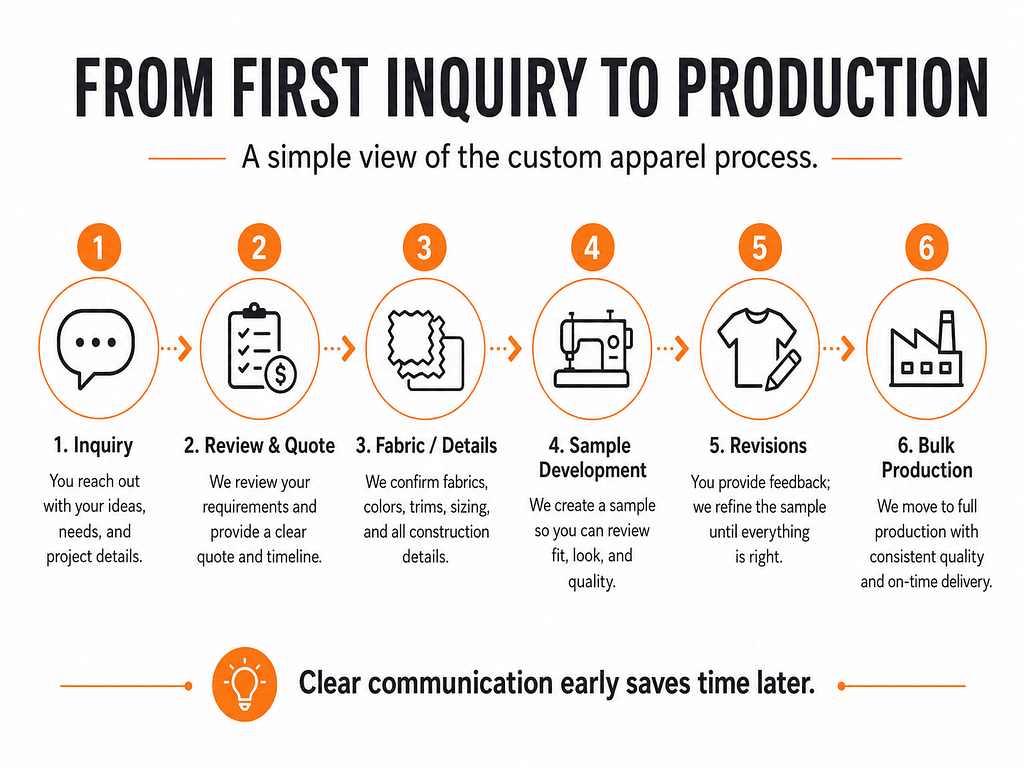
Many new brand owners want to start small.
That is understandable. When you are launching a new brand, you may not want to take too much inventory risk. You may want to test the market first and reorder later.
But from the manufacturing side, even a small order still requires a full production process.
The factory still needs to check the design, source fabric, source trims, make or adjust the pattern, arrange cutting, arrange printing or embroidery, sew the garments, finish them, inspect them, pack them, and ship them.
Many of these steps do not become much easier just because the quantity is small.
In fact, very small orders can be harder to manage because the setup work is almost the same, but the quantity is too low to spread out the cost.
This is why many custom clothing manufacturers cannot easily work with orders such as:
- 30 pieces per style
- 50 pieces per style
- 100 pieces split into several colors
- one style with too many colors and too many sizes
- very low quantity combined with a very low target price
From the buyer’s side, “100 pieces” may sound like a real order.
From the factory’s side, if those 100 pieces are split into 4 colors and 6 sizes, it becomes many tiny orders inside one order.
This does not mean small brands are not welcome.
Many manufacturers are open to working with new brands, especially if the project is clear, the quality expectation is realistic, and the buyer understands the production process.
But if your quantity is small, it is better to say so clearly from the beginning.
For example:
“We are a new brand and would like to start with around 100–150 pieces for our first style. We understand this may affect the unit price, and we would like to know what is workable for your factory.”
This type of message is much better than hiding the quantity or only saying:
“We want to start small.”
A good manufacturer does not need to know your entire business plan. But they do need enough information to judge whether your product, quantity, quality expectation, and budget can work together.
What If You Don’t Have a Tech Pack Yet?
A tech pack is very helpful when contacting a clothing manufacturer.
It usually includes the design sketch, measurements, fabric details, trims, labels, artwork placement, size grading, construction notes, packaging requirements, and other production information.
If you already have a tech pack, send it with your inquiry.
But if you do not have one yet, do not panic.
Many new brands contact manufacturers before they have a complete tech pack. That is normal at the early development stage.
The important thing is to provide enough information for the manufacturer to understand your idea.
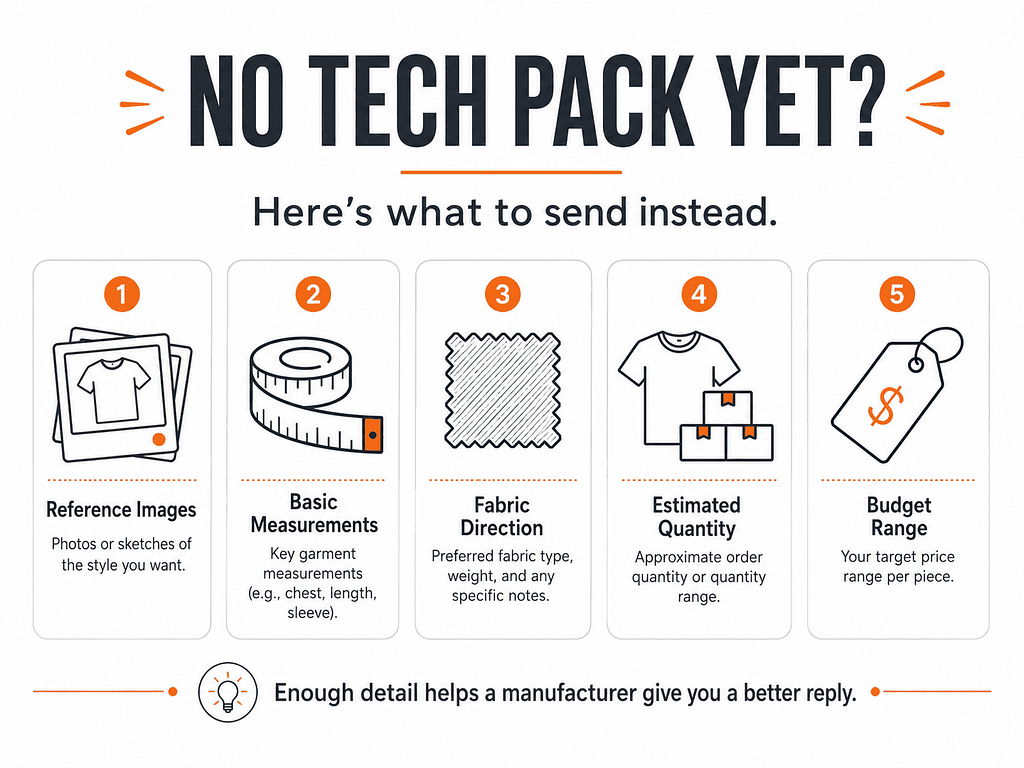
If you do not have a tech pack, prepare these instead.
| If You Don’t Have a Tech Pack | What to Prepare Instead |
| No design sketch | Clear front, back, side, and detail reference images |
| No full size chart | Basic measurements from a similar garment |
| No fabric specification | Fabric hand feel, weight direction, or reference fabric |
| No final artwork | Logo size, placement, and file status |
| No final quantity | Estimated first order quantity by style and color |
| No confirmed budget | Target quality level or expected price range |
Clear Reference Images
Send multiple reference images if possible.
A front view is helpful, but it is usually not enough. Try to include the back view, side view, close-up details, fit references, fabric texture, and any special design features.
If your design is inspired by different products, explain which part of each reference you like.
For example:
“We like the oversized fit from image A, the neckline from image B, and the sleeve shape from image C.”
This is much clearer than sending one image and saying:
“Can you make this?”
Basic Measurements
If you do not have a full size chart, provide basic measurements for at least one size.
For a T-shirt or hoodie, this may include body length, chest width, shoulder width, sleeve length, and hem width.
For pants, this may include waist, hip, outseam, inseam, thigh, and leg opening.
If you are not sure how to create measurements, take a garment from your own wardrobe that fits the way you like, lay it flat, and measure it.
This gives the manufacturer a better starting point than words like “oversized,” “relaxed,” “slim,” or “premium fit.”
Those words can mean different things to different people. Measurements make the idea more concrete.
Fabric Direction
Even without a tech pack, try to describe the fabric you want.
You can mention the fabric type if you know it, such as cotton jersey, French terry, fleece, denim, nylon spandex, modal, linen, or rib fabric.
If you do not know the fabric name, describe the hand feel and use:
- soft and breathable
- heavyweight and structured
- stretchy and supportive
- smooth and drapey
- warm and brushed inside
- lightweight for summer
- suitable for activewear
- suitable for pajamas
- suitable for premium streetwear
If you have enough time and budget, you can ask the manufacturer to send fabric swatches before sampling.
If your timeline is tight, you can start the sample first and ask the manufacturer to include some alternative fabric swatches when they ship the sample. This can help you compare options for the next revision or bulk production.
Artwork and Logo Files
If your product includes printing, embroidery, woven labels, heat transfer, or other branding details, prepare your artwork files as early as possible.
Editable files such as AI, PDF, PSD, or high-resolution artwork are much more useful than screenshots.
If the artwork is not final yet, tell the manufacturer.
For example:
“We plan to add a chest embroidery logo around 8cm wide. The final AI file is still being prepared.”
This is much more useful than simply saying:
“We want a logo on it.”
Without a tech pack, your inquiry should work like a simple project brief.
It should answer:
- What are you trying to make?
- What does it look like?
- How should it fit?
- What fabric direction do you prefer?
- How many pieces do you want to produce?
- What price range or quality level are you aiming for?
- When do you need it?
If you can answer these questions, you are already much easier to reply to than most vague inquiries.
Bad Inquiry vs. Better Inquiry
Sometimes the easiest way to understand a good inquiry is to compare it with a weak one.
A weak inquiry is not always written by an unserious buyer. Many new brand owners simply do not know what information a manufacturer needs.
But from the factory’s side, a vague inquiry creates uncertainty.
Example 1: T-Shirt Inquiry
| Weak Inquiry | Better Inquiry |
| “Hi, I want to make T-shirts. Can you send me your catalog and price?” | “Hi, we are developing a custom oversized T-shirt for our first collection. We are planning around 150 pieces in one color across 5 sizes. We do not have a full tech pack yet, but we can share reference images, logo artwork, and basic measurements from a T-shirt we like. We are looking for a mid-to-premium cotton jersey fabric, around 220–260gsm, with screen printing on the front and a custom neck label. Could you please let us know if this is suitable for your factory, and share your sample cost, MOQ, estimated bulk price range, and production lead time?” |
The better version is not perfect, but it is much easier for a manufacturer to answer.
It tells the factory what product you want to make, whether it is custom production, your approximate quantity, how many colors and sizes, what fabric direction you prefer, what decoration is needed, and what information you want from the factory.
Example 2: Hoodie Inquiry
| Weak Inquiry | Better Inquiry |
| “Can you make this hoodie? What is your best price?” | “We are looking to produce a custom oversized hoodie for our streetwear brand. The reference image shows the fit and general style we like. Our first order plan is around 150 pieces in black, across 5 sizes. We prefer a heavyweight cotton fleece fabric, around 380–450gsm if possible. The hoodie will include chest embroidery, a woven neck label, and custom hang tag. Our target is a premium feel rather than the lowest price. Could you advise your sample cost, estimated production price range, and lead time?” |
A good inquiry does not need to be full of technical terms. It just needs to make the project clear enough for the manufacturer to understand what you are asking.
How to Ask About Price Without Wasting Time
Price is usually one of the first things buyers want to know.
That is completely normal.
But in clothing manufacturing, “How much?” is rarely enough.
A manufacturer cannot give a useful price without understanding the style, fabric, quantity, size breakdown, decoration, labels, packaging, and quality level.
So instead of asking:
“What is your best price?”
Ask something more specific:
“Based on this style, estimated quantity, and fabric direction, could you provide an approximate price range?”
Or:
“We understand the final price depends on the confirmed tech pack and sample, but could you let us know the estimated bulk price range for this type of product?”
Before sampling, a manufacturer may only be able to provide an estimated range. After the fabric, construction, artwork, trims, measurements, and sample are confirmed, the price can become more accurate.
What Affects Clothing Manufacturing Price?
| Price Factor | Why It Matters | Buyer Tip |
| Fabric type and weight | Fabric is often one of the biggest cost factors | Share your target GSM or hand feel |
| Quantity per color | Higher quantity can improve cutting and production efficiency | Avoid splitting small orders into too many colors |
| Garment construction | Complex seams, panels, linings, or special details add labor | Send clear reference images or tech packs |
| Decoration | Embroidery, printing, appliqué, and washing vary in cost | Explain artwork size, placement, and technique |
| Labels and packaging | Custom trims may have their own MOQ | Mention label and packaging needs early |
| Timeline | Urgent orders may be harder to arrange | Plan enough time for sampling and revisions |
| Quality level | Premium fabrics and finishing cost more | Share whether you want basic, mid-range, or premium quality |
If you have a target price, it is better to share it early.
If your budget is too low for the original design, the factory may suggest changes such as using a more cost-effective fabric, simplifying the construction, reducing embroidery size, changing embroidery to print, removing a special wash, using standard trims, or increasing quantity to improve unit cost.
If your budget is suitable for a higher-quality product, the factory may recommend better fabrics, better finishing, or more premium workmanship.
The goal is not to force a final price in the first message.
The goal is to start a practical conversation.
What Makes a Factory More Likely to Reply?
Factories receive many inquiries.
Some are serious and ready to move forward. Some are still early ideas. Some are only collecting prices. Some do not match the factory’s MOQ, product category, or production model.
A manufacturer is more likely to reply when your inquiry shows that your project is clear and workable.
Good signals include:
- You know what product you want to make.
- Your quantity is clear by style, color, and size.
- Your budget is realistic for the product and quantity.
- You understand the difference between custom production and ready stock.
- You are ready to pay for sampling before bulk production.
- You are not only asking for a random catalog or the lowest possible price.
For custom apparel, sampling is usually an important step. The sample helps confirm the fit, fabric, workmanship, decoration, labels, and overall product direction before bulk production.
So instead of only asking for the lowest bulk price, you can write:
“We would like to start with a development sample before bulk production. Please let us know your sample cost and sample lead time.”
This tells the manufacturer that you understand the basic production process and are more likely to be a serious buyer.
Common Mistakes That Make Manufacturers Ignore an Inquiry
Many weak inquiries fail for the same reasons. Here are the most common mistakes to avoid.
| Mistake | Why It Hurts Your Reply Rate | Better Approach |
| Asking only for a catalog | Custom factories may not sell ready-stock styles | Explain whether you need custom production or blanks |
| Sending only one image | One photo does not show full production requirements | Send multiple references and explain the details |
| Giving no quantity | Factory cannot judge MOQ or price | Share quantity per style, color, and size |
| Splitting small quantity into too many colors | Each color becomes too small to produce efficiently | Start with fewer colors for the first order |
| Hiding the budget | Factory may quote the wrong quality level | Share a target range or quality expectation |
| Asking only for the lowest price | May signal that quality is not important | Explain your quality level and product positioning |
| Expecting instant final price | Final price depends on fabric, sample, and confirmed details | Ask for an estimated range first |
| No timeline | Factory cannot check sampling or production feasibility | Share your launch date or target schedule |
A clear inquiry does not guarantee that every factory will reply. But it gives your message a much better chance of being taken seriously.
Clothing Manufacturer Inquiry Template
You can use the template below when contacting a custom clothing manufacturer.
Subject: Custom [Product Type] Manufacturing Inquiry – [Brand Name]
Hello [Manufacturer Name],
My name is [Your Name], and I am developing [product type] for [brand name / market / collection].
We are looking for a custom clothing manufacturer to help with sampling and bulk production.
Here are the project details:
- Product: [T-shirt / hoodie / activewear set / jacket / etc.]
- Quantity: Around [number] pieces per style/color
- Sizes: [size range]
- Colors: [color plan]
- Fabric direction: [fabric type, GSM, or hand feel]
- Decoration: [printing / embroidery / wash / labels / trims]
- Tech pack: [attached / not ready yet]
- Reference images: [attached / available]
- Target price: Around [price range], depending on fabric and workmanship
- Timeline: [sample deadline / launch date / bulk delivery target]
- Shipping country: [country]
Could you please let us know whether this project is suitable for your factory?
We would also like to know your sample cost, sample lead time, MOQ, estimated bulk price range, and production lead time.
Thank you, and I look forward to your feedback.
Best regards,
[Your Name]
FAQ: Clothing Manufacturer Inquiries
1. Do I need a tech pack before contacting a clothing manufacturer?
A tech pack is very helpful, but it is not always required for the first inquiry. If you do not have a tech pack yet, you should provide clear reference images, basic measurements, fabric direction, quantity, target price, and timeline. This allows the manufacturer to understand your idea and decide whether they can help.
2. Can a manufacturer give me a price from only one photo?
Usually, only a very rough estimate is possible from one photo. A photo does not show fabric weight, construction details, measurements, labels, decoration methods, quantity, or packaging. To receive a useful quote, you should provide more production details.
3. Why do manufacturers ask for MOQ?
MOQ helps the factory manage fabric sourcing, cutting, sewing, dyeing, printing, embroidery, and production planning. Very small orders can be difficult because the setup work is similar to a larger order, but the cost is spread across fewer pieces.
4. Should I share my target price with a clothing manufacturer?
Yes, sharing a realistic target price or budget range can make the conversation more efficient. It helps the manufacturer recommend suitable fabrics, processes, and construction methods. If the target price is not workable, you can find out early and adjust the design or quantity.
5. What should I send if I do not know the fabric name?
You can describe the hand feel, weight, stretch, texture, and product use. For example, you can say you want a soft mid-weight cotton fabric for premium T-shirts, a heavyweight structured fleece for hoodies, or a breathable stretchy fabric for activewear.
6. Why does the factory not reply when I ask for a catalog?
Many custom clothing factories do not mainly sell ready-made catalog styles. They produce based on customer designs, tech packs, reference images, fabrics, labels, and order quantities. If you need custom production, it is better to explain your product idea instead of only asking for a catalog.
7. Can I start with a small order?
Some factories can support smaller first orders, but it depends on the product, fabric, color count, size range, and target price. A small order with too many colors and sizes can be difficult. If your quantity is small, explain it clearly and ask what is workable.
8. What is the best way to get a faster reply from a manufacturer?
Send a clear project brief. Include your product type, reference images or tech pack, quantity per style and color, size range, fabric direction, decoration details, target price, timeline, and shipping country. The clearer your inquiry is, the easier it is for the factory to reply.
Final Thoughts
Writing a good clothing manufacturer inquiry is not about using perfect industry language.
It is about giving the manufacturer enough information to understand your project and decide how they can help.
You do not need to have everything finished before you contact a factory.
You may not have a complete tech pack yet. You may still be choosing fabric. You may still be developing your size chart. You may still be comparing production options.
That is normal.
But your first message should still make your project clear.
Tell the manufacturer what you want to make, how many pieces you are planning, what quality level you are aiming for, whether you have reference images or a tech pack, what your budget range looks like, and when you hope to start.
A vague inquiry creates more questions.
A clear inquiry makes it easier for the manufacturer to reply, guide you, and decide whether your project is a good fit.
At Valtin Apparel, we mainly focus on custom apparel production rather than ready-stock catalog styles. Our typical MOQ is 150 pieces per color per style, usually across 4–6 sizes.
If you are developing custom T-shirts, hoodies, activewear, pajamas, jackets, or other apparel styles, you do not need to have every detail perfect before reaching out.
But the more clearly you can share your style idea, quantity, budget range, and timeline, the easier it is for us to give you a useful answer and help move your project forward.
Planning a custom apparel project?
Send us your tech pack, reference images, quantity per style and color, size range, fabric preference, decoration details, target price, and timeline. Our team can review your project and let you know whether it is suitable for sampling and bulk production.